
Industrial Boiler Efficiency: How It Is Measured and Where It Is Lost
Industrial boiler efficiency is not one number. Three different figures carry that name, they can sit fifteen points apart on the same boiler, and only one of them matches the fuel invoice. This guide sets out what each one measures, how to calculate it, where the heat actually goes, and which of those losses can be bought back.
What is boiler efficiency?
Boiler efficiency is the ratio of useful energy leaving the boiler to the energy entering it as fuel. Everything that follows is a disagreement about what counts as leaving, and what counts as entering.
| Measure | What it counts | Where you see it |
|---|---|---|
| Combustion efficiency | Heat carried away by the flue gas, and any fuel that fails to burn. Ignores everything the boiler shell loses. | Burner tuning reports, flue gas analyser printouts |
| Fuel-to-steam efficiency | Combustion losses plus radiation and convection from the boiler itself. | The manufacturer’s datasheet. Governed by ASME PTC 4. |
| In-service efficiency | All of the above, plus start-ups, purge cycles, blowdown, standby and part-load operation over a real year. | Nowhere — you have to calculate it. It is the one that matches the fuel bill. |
The three are quoted interchangeably, and they should not be. A boiler advertised at 85 % fuel-to-steam can run below 70 % in service. That gap is rarely a defect in the boiler. It is the accumulated cost of decisions about sizing, controls and operation — which is also why it can be recovered without replacing anything.
How industrial boiler efficiency is measured
Two methods are standardised, both under ASME PTC 4, Fired Steam Generators. They answer different questions.
Direct method (input–output)
Efficiency = [ steam flow × (steam enthalpy − feedwater enthalpy) ] ÷ ( fuel flow × heating value ) × 100
You need a steam meter, a fuel meter, feedwater temperature and steam pressure. The arithmetic is trivial; the accuracy is not. A 2 % error on the steam meter is a 2 % error on the answer, and the method tells you what the efficiency is without ever telling you why.
Indirect method (heat loss, or energy balance)
Efficiency = 100 − sum of the measured losses
The losses accounted for are:
- Dry flue gas loss
- Moisture formed by the hydrogen in the fuel
- Moisture in the fuel and in the combustion air
- Radiation and convection from the boiler surface
- Blowdown
- Unburned combustibles
This one needs a flue gas analyser — oxygen or carbon dioxide, carbon monoxide, stack temperature — plus ambient temperature and a fuel analysis. More instrument work, but every loss is named, and a named loss can be acted on. If the question is where do I get the efficiency back, this is the method.
One caution about fuel input
Both methods start from the same denominator: the energy in the fuel. Be consistent about which heating value you use. North American practice quotes the higher heating value; many European datasheets quote the lower heating value, which makes the identical boiler look several points better. Comparing two quotations without checking this is the most common way to buy the wrong boiler.
Where the energy goes
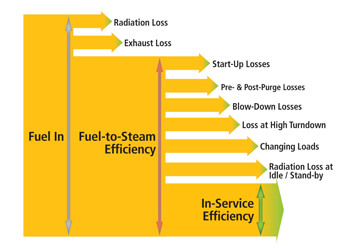
Each arrow on the diagram is energy that entered as fuel and left as something other than usable steam.
Fuel in
The starting point: all the energy contained in the fuel feeding the boiler. Everything downstream is a subtraction.
Losses at the boiler itself
- Radiation loss — heat emitted from the boiler’s surface.
- Exhaust loss — hot gases expelled through the flue carry away a significant amount of unrecovered heat.
Losses that only appear in service
- Start-up losses — every start is a period of inefficiency before the boiler reaches stable operation.
- Pre- and post-purge losses — the air blown through the boiler before and after a firing cycle leaves with heat in it.
- Blowdown losses — water discharged to remove impurities takes its heat with it.
- Losses at high turndown — efficiency falls when the boiler runs at reduced load.
- Changing loads — rapid swings in steam demand disrupt combustion control.
- Standby radiation — an idle boiler kept hot keeps losing heat.
Steam quality
In-service efficiency is also reduced by poor steam quality, when water is carried over with the steam. That water has to be removed by steam traps, and it leaves at saturation temperature — a loss that never appears in any efficiency rating.
Stack loss: the single biggest lever
Most of what a well-maintained boiler loses goes up the chimney, and it is governed by two variables.
Flue gas temperature
Heat leaving the stack is heat you paid for. For natural gas at 15 % excess air, the relationship is close to linear across the normal operating range:
| Flue gas temperature at boiler outlet | Combustion efficiency | |
|---|---|---|
| 130 °F | 54 °C | 89 % |
| 340 °F | 171 °C | 83 % |
| 590 °F | 310 °C | 78 % |
That works out to roughly one point of combustion efficiency for every 40 °F (22 °C) of stack temperature removed. The US Department of Energy publishes the same rule, and adds a second one: one point for every 15 % reduction in excess air. The full curve is in the bulletin on combustion efficiency versus gas temperature.
A stack temperature that climbs at a constant firing rate and constant excess oxygen is the clearest early warning of fouling on the water side — and, as the next section shows, the most expensive one to ignore.
Excess air
Too little air leaves fuel unburned and produces carbon monoxide, which is a safety problem before it is an efficiency problem. Too much air means heating nitrogen and sending it out of the chimney. Natural gas typically runs at 2 to 3 % oxygen in the flue gas, roughly 10 to 15 % excess air — and the Department of Energy notes that 10 % is attainable on a well-designed natural gas system.
An economizer attacks the first variable. Oxygen trim attacks the second. They are not alternatives — a plant that fixes the stack temperature and leaves the burner running at 6 % oxygen has done half the job.
Blowdown loss, and why you cannot simply close the valve
Blowdown removes the dissolved solids that would otherwise scale the tubes or carry over into the steam. The water leaving is at saturation temperature and full pressure, and it takes its enthalpy with it.
The rate is set by the ratio of feedwater dissolved solids to the maximum concentration allowed in the boiler — not by preference. Reducing it means treating the feedwater or returning more condensate. Closing the valve to save fuel produces scale, and scale is the more expensive of the two problems by a wide margin:
| Scale thickness | Fuel loss, normal scale | Fuel loss, high-iron scale | |
|---|---|---|---|
| 1/64 in | 0.4 mm | 1.0 % | 1.6 % |
| 1/32 in | 0.8 mm | 2.0 % | 3.1 % |
| 3/64 in | 1.2 mm | 3.0 % | 4.7 % |
| 1/16 in | 1.6 mm | 3.9 % | 6.2 % |
Half a millimetre of ordinary scale therefore costs about as much fuel as the blowdown it was meant to save — and it does so permanently, whereas the blowdown at least leaves with the solids it was sent to remove. Use the blowdown percentage calculator to size the rate against your own water chemistry, and the conductivity conversion between ppm and µS/cm if your readings and your limits are in different units.
Blowdown heat is recoverable. A flash vessel and a heat exchanger return most of it to the feedwater.
Why 85 % on the datasheet becomes 60 % in service
It is not unusual to see a fuel-to-steam efficiency of 80 to 85 % on a boiler fitted with a good economizer, and to measure something close to 60 % across a year of operation. Four causes account for most of that gap.
- Oversizing. A boiler sized for a peak that occurs twice a year spends the other fifty weeks at low fire or cycling on and off. The peak is real; sizing the whole plant around it is a choice, and a modular or lead-lag arrangement is usually the cheaper answer.
- Cycling. Every start sweeps the boiler with ambient air before and after firing. Each purge carries heat out of a boiler you have just paid to heat. A unit that starts several times an hour pays this over and over, and the loss appears in no efficiency rating.
- Turndown. Efficiency peaks at around 75 % of rated output, and below that point it falls away — slowly at first, then steeply. Measured against the optimum, a boiler running at half load gives up roughly two points; at 30 % load, closer to eight; at 20 %, around fifteen. That is what makes oversizing expensive. An oversized boiler does not simply idle: it operates permanently on the losing side of its own efficiency curve, and the further down the range it sits, the faster the loss grows.
- Controls. No oxygen trim, no lead-lag sequencing across multiple boilers, no night or weekend setback. Each of these is a few points, and they compound.
The load-versus-efficiency curve is in the bulletin on combustion efficiency versus gas temperature, with the reasoning behind its shape: combustion efficiency rises as the flue gas cools at low fire, but radiation losses stay constant in absolute terms and take an ever larger share of a shrinking output. Below about 75 %, the second effect wins.
The arithmetic needs no fuel price to be persuasive. Fuel consumption is inversely proportional to efficiency, so a plant delivering the same steam at 60 % instead of 82 % burns about 37 % more fuel — every year, for the twenty-year life of the boiler. Nothing about that ratio depends on where the plant is or what it pays for gas.
Typical efficiency by boiler type
Ranges, not promises. The actual figure depends on the burner, the load profile and the feedwater temperature far more than on the badge.
| Configuration | Fuel-to-steam | What decides where you land |
|---|---|---|
| Firetube, natural gas, no economizer | 78–82 % | Stack temperature and excess air |
| Firetube with economizer | 83–86 % | Feedwater temperature entering the economizer |
| Firetube with condensing economizer | up to 90 %+ | Only if the return water is cold enough to condense the flue gas |
| Watertube / flextube | comparable range | Faster response and lower water volume, not higher steady-state efficiency |
| Electric | ≈ 99 % at the boiler | No flue, no combustion loss — but the comparison that matters is the cost and carbon of the electricity |
On the difference in construction rather than in efficiency, see the comparison between firetube and flextube boilers. For electric units, the conversion of HP to kW is the starting point for any cost comparison.
And the twenty-year-old boiler?
Age by itself is not the problem. A well-maintained firetube of that vintage can still hold close to its original fuel-to-steam efficiency. What degrades is everything around it: fouling on the fire side and the water side, a burner whose settings have drifted, worn refractory and insulation, and a control system from before oxygen trim was standard. Measure it before you replace it — the gap is often in the controls, and the controls are a fraction of the price of a boiler.
How to improve industrial boiler efficiency
Roughly in order of return on investment, though the order changes with the plant.
- Economizer. Recovers stack heat into the feedwater. The single largest measure on most boilers without one.
- Burner tuning and oxygen trim. Cheap, fast, and it decays — a tune-up is not permanent.
- Condensate return. The hottest and cleanest feedwater available, already treated and already paid for. It raises efficiency and cuts blowdown at the same time.
- Blowdown heat recovery. A flash vessel and a heat exchanger.
- Feedwater temperature. Every degree gained upstream is a degree the boiler does not have to supply.
- Controls. Lead-lag across multiple boilers, setback on nights and weekends, and a strategy that keeps one boiler at good load rather than three at low fire.
- Insulation and a steam trap survey. Unglamorous, and routinely worth more than expected.
Measure before and after with the same method, at the same load. An efficiency gain calculated by one method in January and another in July is not a gain, it is a change of instrument. The bulletin on feed water temperature and the pump sizing bulletin cover the feedwater side.
How to analyse your boiler’s performance
A sequence that a plant can run without outside help.
- Establish a baseline. Fuel and steam totals over one representative month, with the production output for the same period.
- Analyse the flue gas at high fire and at low fire. Oxygen, carbon monoxide, stack temperature, ambient temperature. Two points, not one — the low-fire reading is where the surprises are.
- Calculate combustion efficiency and compare it with the datasheet.
- Calculate in-service efficiency from the meters and compare it with step 3. The difference between them is your operational loss, and it is the number worth acting on.
- Check the water side. Feedwater dissolved solids, boiler water dissolved solids, and the blowdown rate you are actually running versus the rate the chemistry requires.
- Measure condensate return as a percentage of feedwater.
- Log burner starts per hour. Cycling is invisible in every other measurement and expensive in all of them.
- Repeat quarterly. A single measurement is a data point; a trend is a diagnosis.
What should trigger an intervention: stack temperature rising at constant load, oxygen drifting from its setting, carbon monoxide appearing at any firing rate, or a blowdown rate above what the water chemistry calls for.
Related calculations: boiler HP to lb/hr, blowdown percentage, and greenhouse gas emissions if the analysis has to serve a reporting obligation as well.
Frequently asked questions
What is the efficiency of a boiler?
It depends which of the three measures is meant. A modern natural gas firetube boiler is typically quoted at 80 to 85 % fuel-to-steam. Its combustion efficiency will read higher, and its in-service efficiency across a real year will read lower — often much lower.
Which boiler has the highest efficiency?
At the boiler itself, an electric boiler: there is no flue and no combustion loss, so essentially all the input energy reaches the water. Among fuel-fired boilers, a condensing unit whose return water is cold enough to condense the flue gas. But the highest efficiency on paper is not the lowest operating cost — that depends on the price of the energy and on the load profile.
How efficient is a 20-year-old boiler?
Closer to its original rating than most people assume, if it has been maintained. What degrades with age is the burner tuning, the fire-side and water-side cleanliness, the insulation and the controls — not the pressure vessel. Measure before replacing.
What is the best high efficiency boiler?
The one matched to the load profile. Judge candidates on turndown range, on whether the return water is cold enough for a condensing economizer to do anything, on the availability of standard parts, and on the controls package. The buyer’s guide sets out the criteria in order.